
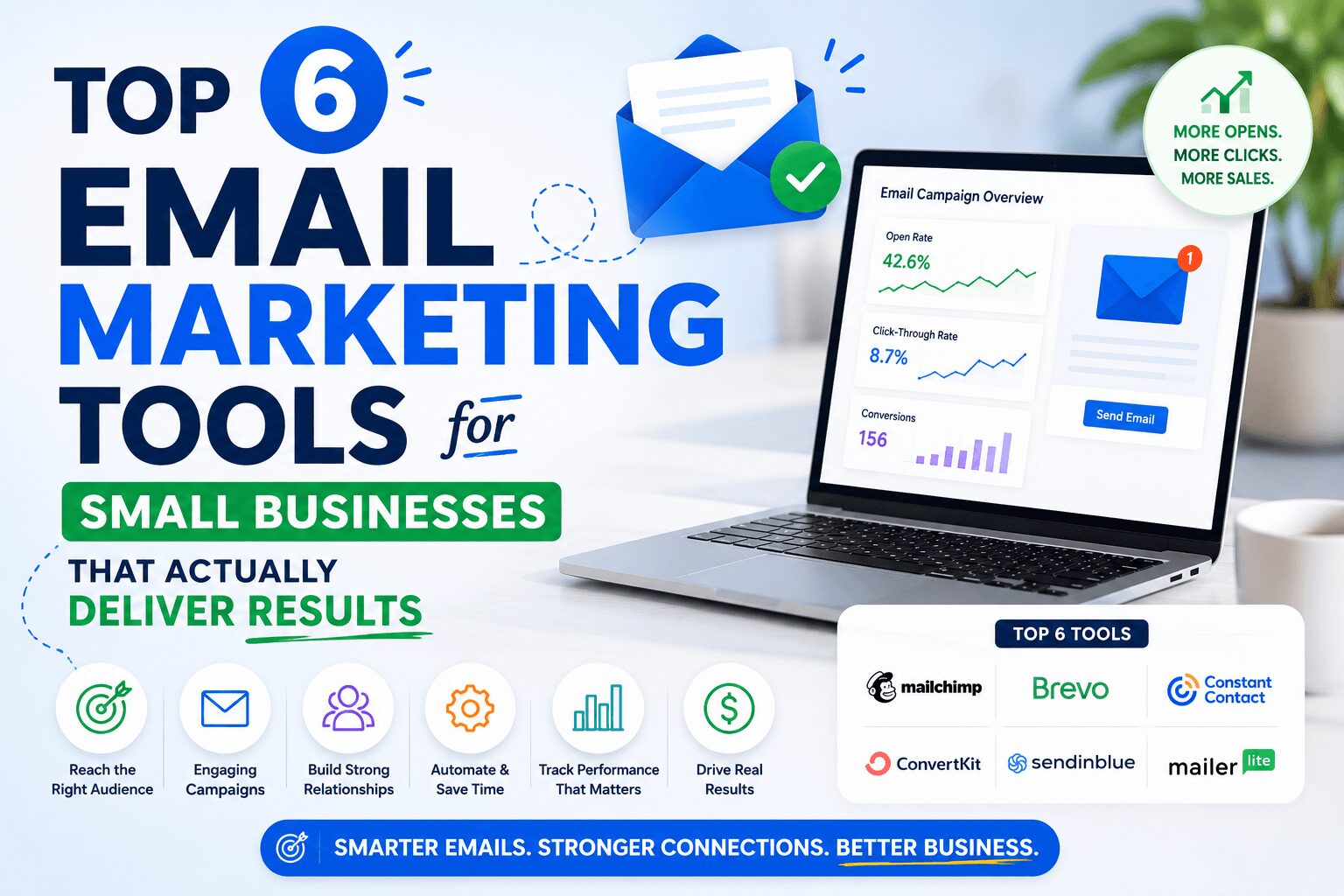
If you’re a small business owner trying to grow online, finding the best email marketing tools for small businesses is one of the smartest moves you can make right now.
Think about it — social media reach is shrinking. Paid ads are getting more expensive. But email? Email still delivers an average return of $36 for every $1 spent, according to Litmus Research. That kind of ROI is hard to ignore.
The challenge is picking the right tool — especially when you’re working with a limited budget and limited time. That’s what this guide is for. No fluff, no filler. Just honest picks that work for real small businesses.
Table of Contents
- Why Small Businesses Need Email Marketing in 2026
- Key Features to Look for Before You Choose
- Best Email Marketing Tools for Small Businesses — Our Top 6
- Quick Comparison at a Glance
- Which Tool Should You Start With?
- Wrap-Up
1. Why Small Businesses Need Email Marketing in 2026 {#why-it-matters}
Here’s something most business owners don’t realise until it’s too late — your Instagram followers don’t belong to you. Your Facebook page reach can be cut in half overnight. But your email list? That’s an asset you own completely.
Email marketing lets you:
- Reach customers directly — no algorithm in the way
- Build trust and loyalty through consistent communication
- Promote products, services, and offers on your own schedule
- Automate follow-ups so you earn while you sleep
For small businesses especially, this kind of direct connection is priceless. You don’t need a massive budget. You just need the right tool and a consistent strategy.
2. Key Features to Look for Before You Choose {#key-features}
Not every email tool is built the same. Before you sign up for anything, check for these must-haves:
A generous free plan — Most small businesses should start free and upgrade only when the ROI justifies it.
Simple drag-and-drop editor — You shouldn’t need a developer to send a beautiful email.
Automation capabilities — Welcome emails, follow-up sequences, and abandoned cart reminders should run on autopilot.
Strong deliverability — Your emails must actually reach inboxes, not spam folders.
Seamless integrations — Look for tools that connect easily with your website, Shopify store, or CRM.
Keep these in mind as you explore the options below.
3. Best Email Marketing Tools for Small Businesses — Our Top 6 {#top-picks}
✅ Mailchimp — The Beginner’s Best Friend

Mailchimp is still the most recognised name in email marketing — and it earns that reputation every year. For beginners, nothing beats its clean interface and zero learning curve.
The free plan covers up to 500 contacts with basic automation included. Perfect if you’re just getting started.
Standout features: Pre-built templates, audience segmentation, A/B testing, detailed reports.
Free plan: Yes — up to 500 contacts Paid plans: From $13/month
✅ MailerLite — Best Value for Growing Teams
If you want Mailchimp-level quality at half the price, MailerLite is your answer. It’s clean, fast, and quietly one of the most capable tools available for small businesses on a budget.
The free plan includes 1,000 subscribers and 12,000 monthly emails — that’s genuinely impressive for $0.
Standout features: Landing page builder, website builder, automation, pop-up forms.
Free plan: Yes — up to 1,000 subscribers Paid plans: From $9/month
✅ Brevo — Best for Businesses with Large Contact Lists

Brevo (formerly Sendinblue) flips the traditional pricing model on its head. Instead of charging per contact, it charges per email sent. That means you can store unlimited contacts for free — a massive advantage for small businesses building a list.
Standout features: SMS marketing, transactional emails, live chat, CRM tools built in.
Free plan: Yes — unlimited contacts, 300 emails/day Paid plans: From $25/month
✅ ConvertKit — Best for Creators and Solopreneurs
Running a blog, podcast, or online course? ConvertKit was designed specifically for independent creators. Its tag-based system makes it incredibly easy to segment your audience and send emails that actually feel personal.
It’s not the cheapest option, but for creator-driven businesses, it’s worth every cent.
Standout features: Visual automation builder, subscriber tagging, landing pages, commerce tools.
Free plan: Yes — up to 1,000 subscribers Paid plans: From $25/month
✅ GetResponse — Best All-in-One Marketing Suite
GetResponse is more than an email tool — it’s a full marketing platform. You get email campaigns, automation, landing pages, webinar hosting, and even an AI email generator, all under one roof.
For small businesses that want to consolidate their marketing stack, this is a seriously smart choice.
Standout features: Webinar hosting, AI email builder, sales funnels, e-commerce tools.
Free plan: Yes — limited features Paid plans: From $19/month
✅ Constant Contact — Best for Local and Event-Based Businesses
Constant Contact has been helping small businesses since 1995. Its real strength lies in simplicity, customer support, and features built specifically for local, retail, and event-driven businesses — like event registration tools and social posting integrations.
If you ever get stuck, their support team is genuinely one of the best in the industry.
Standout features: Event management, social media integration, branded template library.
Free plan: 60-day free trial Paid plans: From $12/month
4. Quick Comparison at a Glance {#comparison}
| Tool | Free Plan | Best For | Starting Price |
|---|---|---|---|
| Mailchimp | ✅ 500 contacts | Beginners | $13/month |
| MailerLite | ✅ 1,000 subscribers | Budget-conscious teams | $9/month |
| Brevo | ✅ Unlimited contacts | Large list builders | $25/month |
| ConvertKit | ✅ 1,000 subscribers | Creators & solopreneurs | $25/month |
| GetResponse | ✅ Limited | All-in-one marketers | $19/month |
| Constant Contact | ❌ (60-day trial) | Local & event businesses | $12/month |
5. Which Tool Should You Start With? {#which-tool}
Still not sure? Here’s a quick decision guide:
You’re brand new to email marketing → Start with Mailchimp. It’s free, friendly, and forgiving.
You need more subscribers for free → Go with MailerLite. Best free plan on the market.
You have a big list but send emails less often → Brevo will save you money every month.
You’re a blogger, coach, or content creator → ConvertKit was literally built for you.
You want one tool to do everything → GetResponse has you covered end to end.
You run a local shop or host events → Constant Contact understands your world.
For more help growing your online presence, check out our guide on how to build an email list from zero and top digital marketing strategies for small businesses — both packed with practical, beginner-friendly advice.
6. Wrap-Up {#wrap-up}
The best email marketing tools for small businesses share one thing in common — they help you build real, lasting connections with your customers without draining your budget or your time.
You don’t need to be a tech wizard. You don’t need a big team. You just need to pick one tool, set it up properly, and start showing up in your customers’ inboxes consistently.
Start free. Learn as you go. Scale when the results justify it.
Your next customer is already on your list — they’re just waiting to hear from you.
Was this guide helpful? Share it with a fellow small business owner — and let us know in the comments which tool you’re planning to try first!
Last updated: May 2026 | Reading time: ~6 minutes
Leave a Reply